Choosing the right DDR4 vs DDR5 laptop RAM is essential for anyone planning to upgrade their laptop in 2025. Laptop memory has evolved quickly, and today’s buyers must compare DDR4 and DDR5 to understand the speed, efficiency, and performance differences. Each RAM type offers unique benefits depending on the user’s needs, such as gaming, multitasking, studying, or professional workloads.
DDR5 RAM – Why DDR5 Is Faster in DDR4 vs DDR5 Laptop RAM Comparison
The newer generation, faster and more efficient.
Both types deliver solid performance, but they serve different user needs.
This guide compares DDR4 vs DDR5 in a simple, practical way so you can choose the right RAM for your next laptop — whether it’s for studying, office work, editing, gaming, or multitasking.
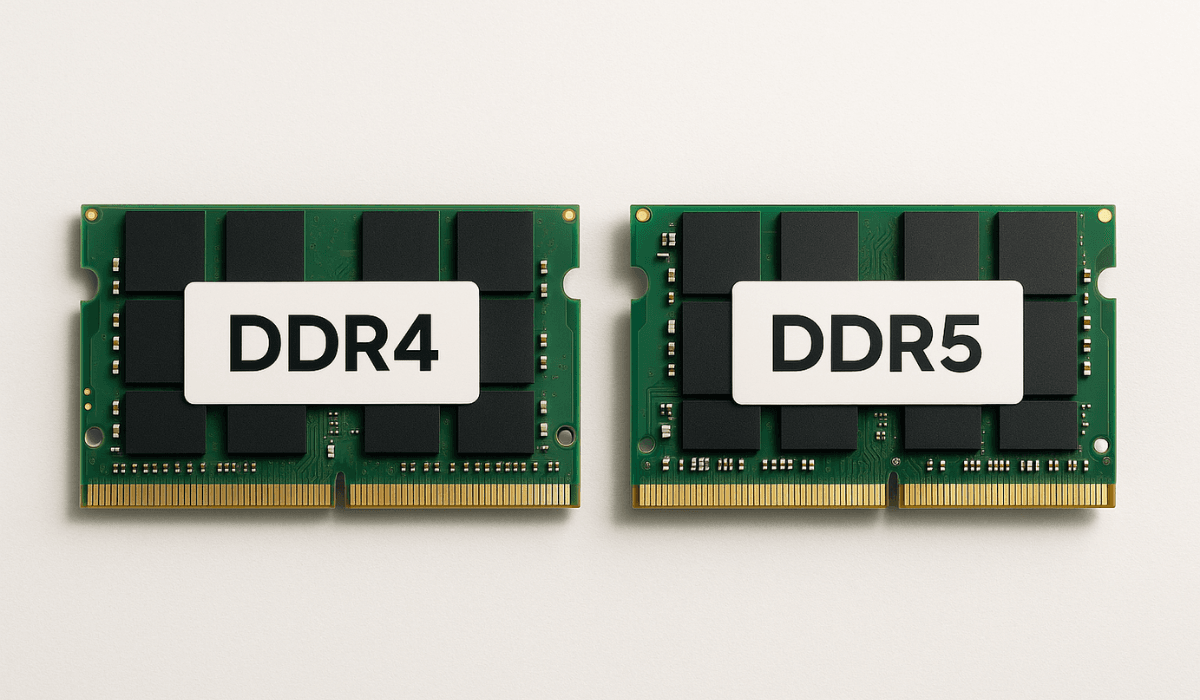
What Is DDR4 RAM?
DDR4 (Double Data Rate 4) RAM is the older generation but still extremely common in laptops.
Key Characteristics:
- Lower cost
- Stable and reliable
- Good for general productivity
- Works well with Intel and AMD processors
- Found in most laptops under mid-range pricing
Typical DDR4 speed ranges:
- 2133 MHz
- 2400 MHz
- 2666 MHz
- 2933 MHz
- 3200 MHz (most common)
DDR4 RAM is still strong for regular users.
What Is DDR5 RAM?
DDR5 is the latest generation of RAM offering:
- Higher bandwidth
- Faster data transfer
- Better power efficiency
- Improved multitasking capability
- Future-proof performance
Common DDR5 speeds:
- 4800 MHz
- 5200 MHz
- 5600 MHz
- 6000+ MHz (high-end models)
DDR5 is mostly found in new laptops with latest Intel and AMD processors.
DDR4 vs DDR5 – Major Differences
🟩 1. Speed (MHz)
DDR4
Up to 3200 MHz
Good speed for normal use.
DDR5
Starts at 4800 MHz
Significantly faster.
Winner: DDR5
Better for multitasking, editing, and gaming.
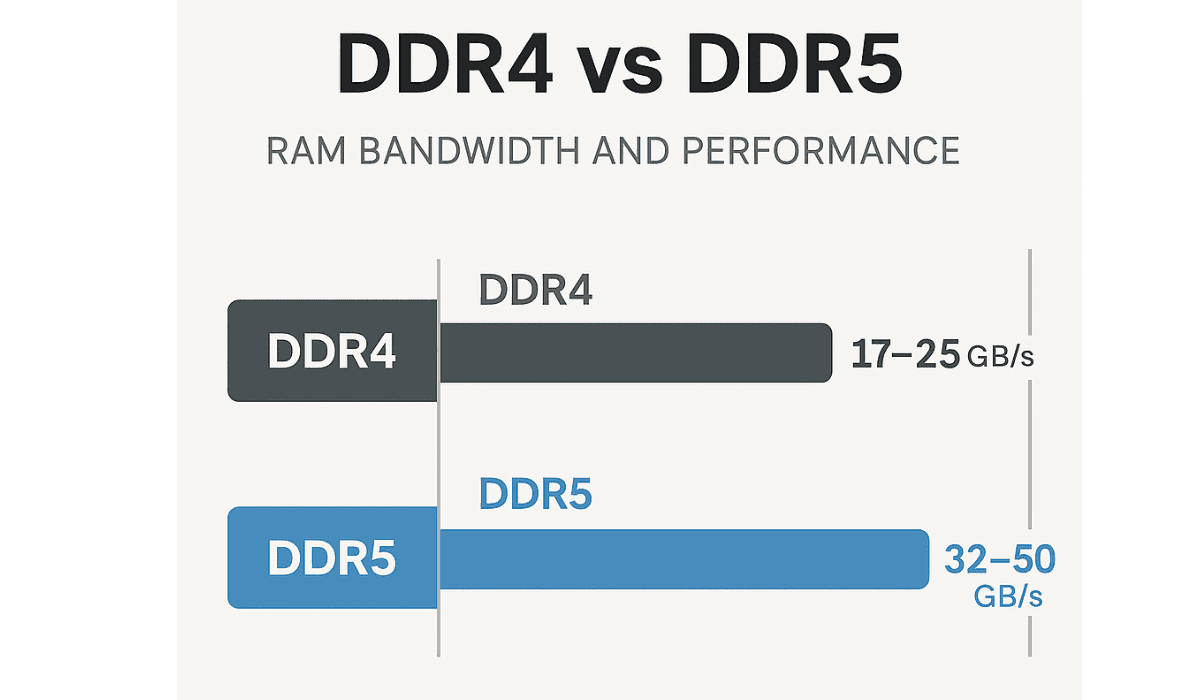
2. Bandwidth
More bandwidth means faster data movement.
DDR4
Lower bandwidth
Good for general tasks.
DDR5
Double the bandwidth of DDR4
Ideal for:
- Gaming
- Video editing
- Large spreadsheets
- Heavy workloads
Winner: DDR5
3. Power Efficiency
DDR5 uses lower voltage while delivering more speed.
DDR4 → 1.2V
DDR5 → 1.1V
This improves battery life slightly.
Winner: DDR5
🟥 4. Latency
Latency affects how quickly RAM responds.
DDR4
Lower latency → faster response
Better for certain tasks.
DDR5
Higher latency
BUT faster MHz cancels out most disadvantages.
Winner: Tie
(Both good depending on workload)
5. Multitasking Performance
DDR5 handles multiple apps better because of higher bandwidth.
DDR4
Great for simple multitasking.
DDR5
Best for heavy multitasking.
Winner: DDR5
6. Gaming Performance
Gaming depends on:
- CPU
- GPU
- RAM bandwidth
DDR5 helps in:
- Higher FPS
- Better smoothness
- Faster texture loading
Winner: DDR5
(But DDR4 is still good for budget gaming)
7. Editing & Creative Work
Editing apps like:
- Adobe Premiere Pro
- After Effects
- Photoshop
- DaVinci Resolve
benefit from DDR5 speed.
Winner: DDR5
8. Price
DDR4 is much cheaper.
Winner: DDR4
Best for budget buyers.
Feature Comparison Table
| Feature | DDR4 | DDR5 | Winner |
|---|---|---|---|
| Speed | Up to 3200 MHz | 4800–6000+ MHz | DDR5 |
| Bandwidth | Good | Very High | DDR5 |
| Power Efficiency | Moderate | Better | DDR5 |
| Latency | Lower | Slightly higher | Tie |
| Productivity | Strong | Stronger | DDR5 |
| Editing | Good | Great | DDR5 |
| Gaming | Good | Better | DDR5 |
| Price | Cheap | Higher | DDR4 |
DDR4 vs DDR5 – Who Should Choose What?
Students
Recommended: DDR4 or DDR5
Students doing:
- Google Docs
- Browsing
- Streaming
- Online classes
→ Both types are equally smooth.
If budget is low → DDR4
If buying a new laptop → DDR5
Office Workers / Remote Work
Recommended: DDR4 or DDR5
Office tasks like:
- MS Office
- Video calls
- 10–20 tabs
- CRM tools
run perfect on both.
Choose DDR5 if you want future-proof performance.
Choose DDR4 to save money.
Programmers
Recommended: DDR5
Why:
- Better compile speeds
- Better performance with multiple tabs
- Faster in virtual machines
DDR4 still works fine for basic coding.
Photo & Video Editors
Recommended: DDR5
Editing apps love high bandwidth RAM.
Benefits:
- Faster export times
- Smoother timeline playback
- Better performance with large files
Gamers
Recommended: DDR5
(Best combined with a good GPU)
Benefits:
- Higher FPS in modern games
- Faster texture loading
- Lower stutters
Budget gamers can still use DDR4 effectively.
Home Users
Recommended: DDR4
For basic tasks (YouTube, browsing), DDR4 is more than enough.
RAM Upgradability
DDR4 laptops often allow:
✔ Easy RAM upgrades
✔ Additional slots
DDR5 laptops:
✔ Many use soldered memory
✔ Fewer upgrade options
✔ Upgrades cost more
Always check before buying.
Brand Compatibility
- Intel Laptops
Support both DDR4 and DDR5 (model dependent)
- AMD Ryzen Laptops
Newer Ryzen chips are optimized for DDR5
Brand links:
- Intel: https://www.intel.com/
- AMD: https://www.amd.com/
- ASUS: https://www.asus.com/
- HP: https://www.hp.com/
- Lenovo: https://www.lenovo.com/
Final Recommendation
Choosing between DDR4 vs DDR5 depends on:
- Budget
- Workload
- Future plans
Here’s the simplest guide:
Choose DDR4 if you want:
- Lower price
- Stable performance
- Great value
- Basic to medium workloads
Choose DDR5 if you want:
- Maximum performance
- Faster speeds
- Better multitasking
- Heavy editing or gaming
- Future-proof laptop
BEST CHOICE FOR MOST USERS
DDR5 + 16GB
(The perfect combo for long-term performance)